NFT Utility Beyond Digital Collectibles
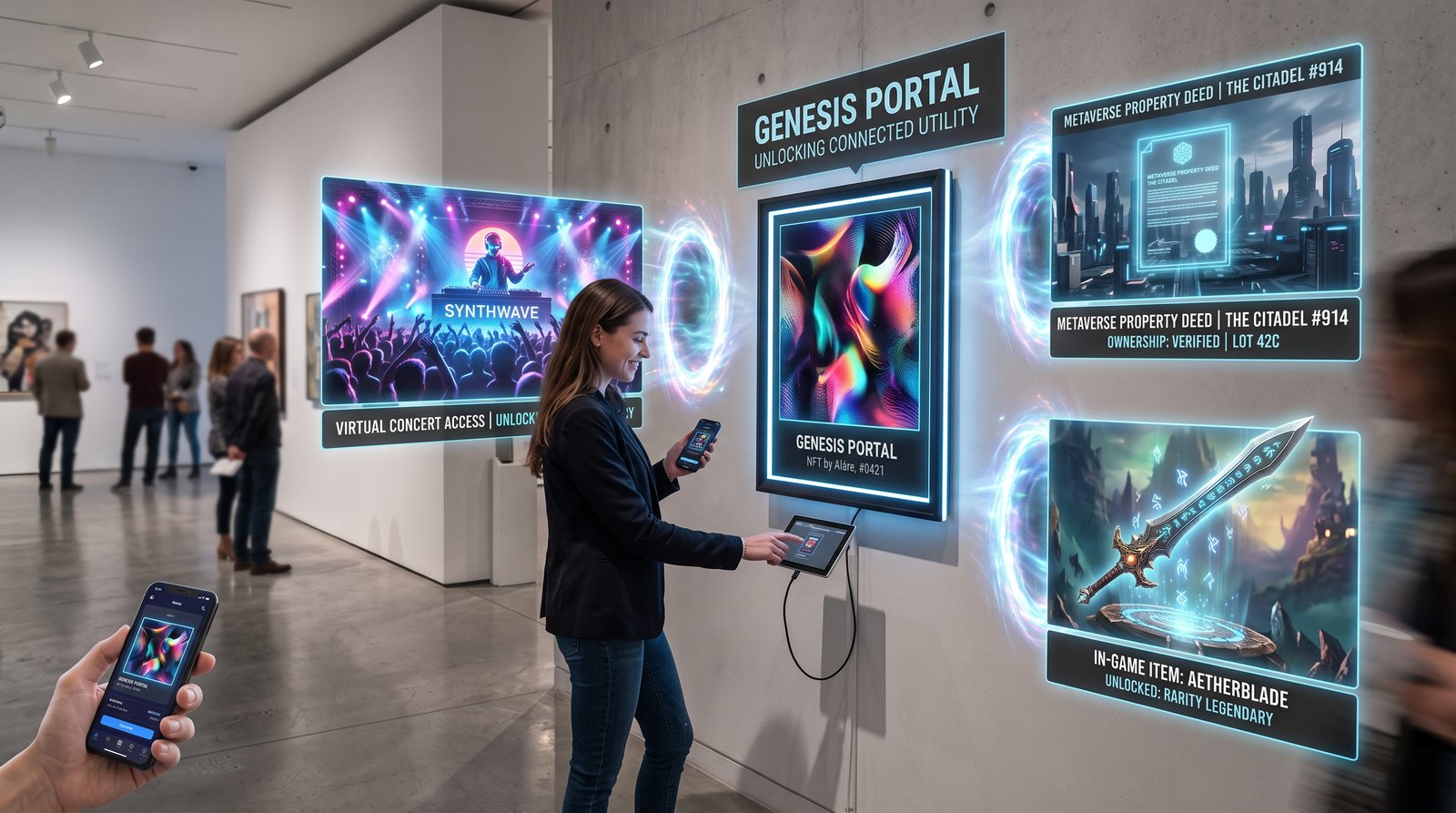
Non-fungible tokens (NFTs) captured mainstream attention through multi-million-dollar digital art sales, but the narrative around NFTs has fundamentally shifted. The speculative frenzy of 2021 has given way to a more sophisticated understanding of what NFTs can actually do. Today, NFTs are being deployed as functional digital assets across industries including real estate, finance, supply chain, identity, entertainment, and enterprise software. This comprehensive guide explores the real utility of NFTs beyond digital collectibles and profile pictures.
What Makes NFTs More Than Just Art?
At their core, NFTs are unique digital tokens on a blockchain that represent ownership of a specific asset or access right. The key innovation of NFTs is not the hype around cartoon apes — it is the ability to create verifiable digital scarcity and provable ownership of any unique item, digital or physical. The programmability of NFTs (through smart contracts) enables them to carry dynamic properties, evolve over time, and interact with other applications in ways that traditional ownership records cannot.
The global NFT market, after contracting sharply in 2022-2023, has rebounded with a focus on utility-driven use cases. Monthly trading volume stabilized around $800 million to $1.5 billion through 2025-2026, but the composition has shifted dramatically — from 80% speculative profile picture trading to over 60% utility-based transactions.
NFTs in Real-World Asset Tokenization
Real Estate and Property Rights
Real estate tokenization is one of the most promising applications of NFT technology. By representing property ownership or fractional shares through NFTs, real estate transactions become faster, cheaper, and more transparent. Smart contracts automate rent collection, property tax payments, and ownership transfers without the need for title companies and escrow agents.
Companies like Propy and RealT have facilitated thousands of real estate transactions using NFTs. Fractional ownership — enabled by dividing a property into multiple NFT shares — allows investors to buy into high-value real estate with as little as $100. The global real estate tokenization market is projected to reach $10 trillion by 2030, representing one of the largest addressable markets for NFT technology.
Luxury Goods and Authentication
Luxury brands have embraced NFTs as digital certificates of authenticity for physical products. When you buy a luxury watch, handbag, or piece of jewelry, the NFT serves as an immutable record of provenance — tracking the item from manufacturer through every owner. This solves the counterfeit problem, which costs the luxury industry over $30 billion annually.
Nike's .SWOOSH platform issues NFTs linked to physical sneakers, enabling digital ownership experiences while authenticating the physical product. LVMH, Prada, and Cartier participate in the AURA blockchain consortium for luxury goods authentication. Breitling issues digital passports for its watches using blockchain technology. These implementations are not speculative — they solve real business problems around authentication, resale, and customer engagement.
Commodities and Precious Metals
Gold and other precious metals are being tokenized through NFTs that represent ownership of specific allocated bars or refined quantities. Tradewind Markets and other platforms issue digital tokens backed by physical gold stored in vaults, enabling instant settlement and fractional ownership that would be impractical with physical metal.
NFTs in Digital Identity and Access
Decentralized Identity and Credentials
NFTs can serve as self-sovereign identity credentials — digital documents that prove who you are without revealing unnecessary personal information. Educational institutions like MIT and the University of Zurich issue NFT-based diplomas that graduates can share with employers without needing to request verification from the university.
Professional certifications, medical licenses, and even vaccination records are being issued as NFTs. These credentials are tamper-proof, instantly verifiable, and controlled entirely by the individual. The recipient chooses when and with whom to share their credential, eliminating the friction of traditional verification processes.
Membership and Access Tokens
NFT-based membership passes have become a standard model for communities, clubs, and services. Instead of traditional subscription billing, organizations issue NFTs that grant access for a specific period or indefinitely. These passes can be transferred, sold, or traded on secondary markets, creating liquidity for membership access.
Examples include the Flyfish Club (an NFT-gated private dining club in New York), Bored Ape Yacht Club (which provides access to member-only events and benefits), and numerous co-working spaces and fitness studios that use NFTs for membership management. The model aligns incentives: members who rarely use the service can sell their pass, while active members can purchase access on the open market.
Event Ticketing
NFT ticketing solves persistent problems in the events industry: counterfeit tickets, scalping, and lack of secondary market control. NFT tickets are cryptographically secured (eliminating counterfeits), smart contracts can enforce price caps on resale (limiting scalping), and artists can earn royalties on every secondary sale.
Platforms like Seatlab, YellowHeart, and GET Protocol have issued millions of NFT tickets for concerts, sports events, and conferences. Coachella, the Super Bowl, and major European football clubs have experimented with NFT ticketing, and the technology is gaining traction for its ability to reduce fraud and give event organizers more control over the secondary market.
NFTs in Gaming and Virtual Worlds
True Digital Asset Ownership
In traditional gaming, players spend billions of dollars on in-game items — skins, weapons, characters, and virtual land — that remain the property of the game company. If the game shuts down, the items are worthless. NFT-based gaming gives players true ownership. Items can be traded on open marketplaces, used across compatible games, and retained even if the developer goes out of business.
While the play-to-earn model faced challenges with economic sustainability, the play-and-earn model — where games are genuinely fun first and economic rewards are a secondary benefit — is gaining traction. Games like Illuvium, Parallel, and Shrapnel have raised significant funding and are building high-quality gaming experiences with NFT-based asset ownership.
Interoperable Gaming Assets
Perhaps the most ambitious vision for gaming NFTs is interoperability — items that work across multiple games. A sword earned in one game could be used in another, creating a unified gaming economy. While full interoperability remains technically challenging, projects like The Sandbox and Decentraland demonstrate how NFT assets can function across different experiences within the same ecosystem.
Virtual Land and Metaverse Parcels
Virtual land in metaverse platforms like The Sandbox, Decentraland, and Somnium Space is represented as NFTs. Owners can develop their land with experiences, games, and storefronts, monetizing through visitor fees, advertising, and virtual commerce. While metaverse land speculation cooled significantly from 2021 peaks, genuine utility is emerging as brands and creators build persistent virtual experiences.
NFTs in Finance and DeFi
NFT-Backed Lending
DeFi lending protocols now accept NFTs as collateral for loans. Platforms like NFTfi, Arcade, and BendDAO allow NFT holders to borrow stablecoins against their digital assets. A Bored Ape worth 50 ETH might secure a loan of 20 ETH, providing liquidity to collectors without requiring them to sell their assets.
Fractionalized NFTs
High-value NFTs can be fractionalized into smaller tokens, enabling shared ownership. A CryptoPunk worth $500,000 might be divided into 10,000 fractions worth $50 each. This democratizes access to valuable digital assets and creates liquidity for otherwise illiquid high-value NFTs. Platforms like Fractional.art (now Tessera) and Unicly facilitate NFT fractionalization.
Soulbound Tokens (Non-Transferable NFTs)
Introduced by Ethereum founder Vitalik Buterin, soulbound tokens are NFTs that cannot be transferred — they are permanently bound to a specific wallet. These represent achievements, credentials, and affiliations that should not be tradeable. Use cases include proof of attendance, academic credentials, employment history, and community reputation. Soulbound tokens create a verifiable on-chain resume that cannot be bought, sold, or falsified.
NFT Market Statistics (2026)
| Use Case | Market Share | Year-over-Year Growth | Example Platforms |
|---|---|---|---|
| Gaming Assets | 32% | +45% | Immutable, Polygon, Ronin |
| RWA Tokenization | 22% | +180% | Propy, RealT, Tradewind |
| Identity & Access | 18% | +65% | POAP, Guild, Civic |
| DeFi & Collateral | 15% | +35% | NFTfi, Arcade, BendDAO |
| Music & Media | 8% | +50% | Sound.xyz, Royal, Catalog |
| Art & Collectibles | 5% | -10% | OpenSea, Blur, Sotheby's |
Frequently Asked Questions About NFT Utility
Are NFTs still a good investment?
The speculative NFT market has matured significantly. Utility-driven NFTs with clear value propositions — such as real estate tokens, gaming assets, or membership passes — offer more sustainable investment cases than purely speculative profile picture collections. Always research the underlying utility and team.
Can NFTs represent physical property?
Yes. NFTs can represent ownership of physical assets including real estate, luxury goods, and commodities. The legal mechanism typically involves a trusted custodian that holds the physical asset while the NFT represents the right to claim it. Smart contracts automate transfer of ownership when the NFT is sold.
What is the environmental impact of NFTs?
Ethereum's transition to Proof of Stake reduced its energy consumption by over 99.9%. Most NFT activity now occurs on energy-efficient networks. A single NFT transaction on Ethereum uses energy equivalent to sending a few emails — dramatically less than the proof-of-work era when NFT minting was criticized for its carbon footprint.
How do NFTs with utility actually work?
Utility NFTs contain smart contract logic that governs their behavior. They can grant access to a service (gateway token), represent ownership of a real-world asset (with legal off-chain agreements), accrue value over time (dynamic NFTs), or evolve based on user actions. The blockchain provides verifiable proof of ownership and programmatic enforcement of rights.
The Future of NFT Utility
The evolution of NFTs from speculative digital art to functional digital assets mirrors the evolution of the internet itself — from novelty to infrastructure. As legal frameworks mature, user interfaces improve, and enterprise adoption accelerates, NFTs will become a standard digital primitive for representing ownership of any unique asset, digital or physical.
Key trends to watch include regulatory clarity around NFT securities classifications, integration with traditional financial systems through institutional-grade custody solutions, and the emergence of NFT-based insurance and derivatives markets. The NFT market of 2026 bears little resemblance to the speculative frenzy of 2021 — and the market of 2030 will likely be equally different, driven by genuine utility rather than hype.