The Role of Artificial Intelligence in Crypto
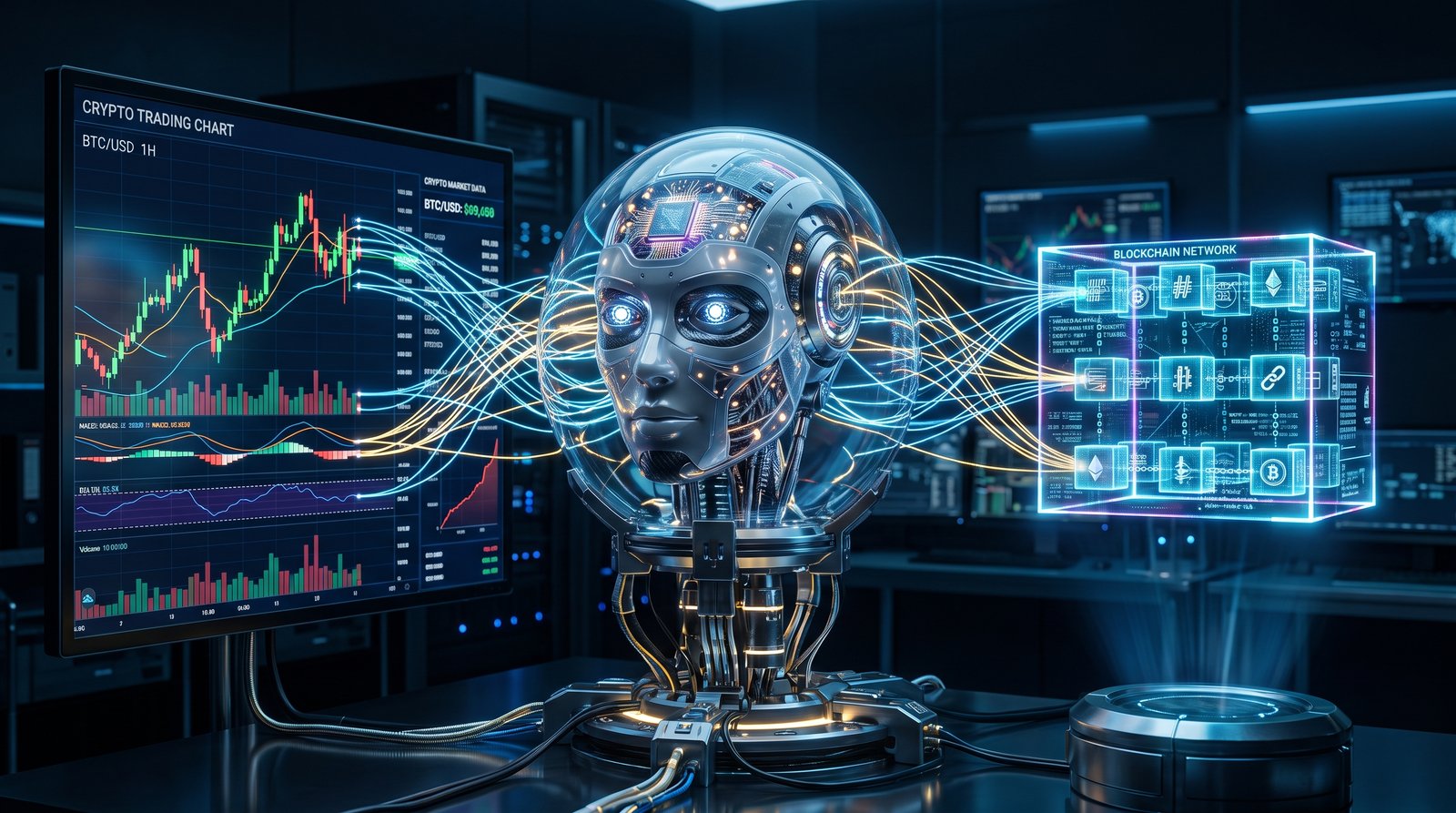
Two of the most transformative technologies of the 21st century — artificial intelligence and blockchain — are converging in ways that promise to reshape entire industries. While AI excels at processing vast amounts of data to generate insights, predictions, and automated decision-making, blockchain provides trust, transparency, and decentralized coordination. This convergence, often called Crypto x AI, represents one of the most exciting frontiers in both technology domains. This comprehensive analysis explores how AI is being integrated into cryptocurrency systems and what this means for investors, developers, and users.
The Convergence of AI and Blockchain
The intersection of AI and blockchain creates value in both directions. AI enhances blockchain applications by enabling smarter trading, automated risk management, advanced data analysis, and intelligent user interfaces. Blockchain improves AI by providing decentralized data marketplaces, transparent model training, verifiable inference, and tokenized incentives for AI development.
The Crypto x AI sector has grown dramatically, with the combined market capitalization of AI-focused crypto tokens exceeding $25 billion as of mid-2026. Venture capital investment in AI-blockchain startups reached over $4 billion in 2025, reflecting strong conviction that the convergence will create significant value.
AI in Crypto Trading and Investing
Algorithmic Trading Bots
AI-powered trading bots have become a cornerstone of crypto markets, accounting for an estimated 70-80% of total trading volume on centralized exchanges and a growing share on decentralized platforms. Modern trading bots use machine learning models to analyze market microstructure, order flow, sentiment data, and on-chain metrics to execute trades with precision that human traders cannot match.
Machine learning approaches like reinforcement learning enable bots to continuously adapt to changing market conditions. These systems process terabytes of data daily — including price feeds, social media sentiment, wallet activity, and macroeconomic indicators — to identify trading opportunities milliseconds before they become apparent to human traders.
AI-Driven Market Analysis
Natural language processing models analyze news articles, social media posts, regulatory announcements, and developer communications to gauge market sentiment and predict price movements. On-chain analysis tools use machine learning to identify whale accumulation patterns, detect exchange flow anomalies, and predict network congestion periods.
Platforms like Santiment, LunarCrush, and Messari increasingly incorporate AI-generated insights into their analytics dashboards, providing traders with AI-powered signals that would be impossible to generate manually. These tools analyze thousands of data points simultaneously and present actionable insights in real-time.
Risk Management and Portfolio Optimization
AI systems help traders and investors manage risk through sophisticated portfolio optimization algorithms. These models consider correlations between assets, volatility regimes, liquidity conditions, and macroeconomic factors to recommend optimal allocations. AI-driven stop-loss systems can adjust position sizes based on real-time volatility measurements, protecting capital during market turbulence.
Decentralized AI Computing Networks
GPU Compute Marketplaces
Training large AI models requires enormous computational resources. Decentralized GPU networks like Render Network, Akash Network, and io.net allow GPU owners to rent their unused processing power to AI developers. This creates a more competitive and accessible market for AI compute, reducing costs compared to centralized cloud providers by 50-80%.
Render Network, originally focused on 3D rendering, has pivoted significantly toward AI inference and training workloads. The network connects over 100,000 GPUs globally, providing decentralized compute for AI applications ranging from image generation to complex model fine-tuning.
Decentralized Data Marketplaces
AI models are only as good as the data they are trained on. Blockchain-based data marketplaces enable individuals and organizations to monetize their data by selling it to AI developers. Ocean Protocol and Streamr facilitate secure, privacy-preserving data sharing through tokenized access controls and encrypted data streams. These platforms ensure data provenance and prevent unauthorized use through on-chain access management.
Federated Learning on Blockchain
Federated learning trains AI models across distributed devices without centralizing raw data. Blockchain adds a layer of incentive alignment and verification to federated learning systems. Participants earn tokens for contributing model updates, and the blockchain provides a tamper-proof record of contributions and model performance. This approach is particularly valuable for privacy-sensitive applications in healthcare and finance.
AI Agents and Autonomous Systems
Decentralized Autonomous Agents
The concept of autonomous AI agents operating on blockchain networks is gaining traction. These agents — sometimes called "smart agents" or "AI DAOs" — can independently manage assets, execute trades, provide services, and interact with other agents through smart contracts. Unlike traditional bots, these agents make decisions using AI models rather than fixed rules, enabling adaptive behavior in complex environments.
Projects like Autonolas (formerly Autonolas) provide infrastructure for building and operating decentralized AI agent networks. Agents on these networks can perform tasks like optimizing DeFi yields, providing automated customer support, managing insurance pools, and coordinating supply chain logistics.
AI-Enhanced Oracles
Oracles provide external data to smart contracts. AI-enhanced oracles go further by not just fetching data, but interpreting it. For example, an AI oracle could analyze satellite imagery, news reports, and shipping data to determine whether a supply chain milestone has been met before releasing payment from a smart contract. Chainlink, the leading oracle network, has been actively researching and implementing AI integration into its oracle services.
AI in Blockchain Security and Auditing
Smart Contract Auditing
AI-powered security tools are transforming smart contract auditing. Machine learning models trained on millions of lines of Solidity code can identify vulnerabilities — including reentrancy attacks, flash loan exploits, and oracle manipulation risks — with speed and accuracy that complement traditional manual auditing. Tools like CertiK's Skynet and OpenZeppelin Defender use AI for continuous security monitoring.
Fraud Detection and Compliance
AI systems monitor blockchain transactions in real-time to detect suspicious activity, including money laundering patterns, rug pull indicators, and market manipulation. Chainalysis, Elliptic, and CipherTrace use AI to help exchanges and regulators identify illicit transactions while reducing false positives compared to rule-based systems.
Notable AI x Crypto Projects
| Project | Category | Market Cap (Billions) | Key Innovation |
|---|---|---|---|
| Render (RNDR) | GPU Compute | $4.8 | Decentralized GPU network for AI rendering |
| Bittensor (TAO) | AI Model Marketplace | $3.2 | Decentralized ML model training and exchange |
| Fetch.ai (FET) | AI Agents | $2.1 | Autonomous AI agent ecosystem |
| Akash Network (AKT) | Cloud Compute | $1.5 | Decentralized cloud for AI workloads |
| Ocean Protocol (OCEAN) | Data Marketplaces | $0.9 | Decentralized data exchange for AI |
| Autonolas (OLAS) | Agent Infrastructure | $0.6 | Decentralized AI agent orchestration |
Challenges and Risks of AI in Crypto
Verification and Trust
A fundamental challenge is verifying that decentralized AI computations are performed correctly. How do you trust that a decentralized GPU network actually executed your model training job faithfully? ZK-proofs for ML inference (zkML) and trusted execution environments (TEEs) are emerging solutions, but they add complexity and cost.
Market Manipulation Risks
AI-powered trading bots can exacerbate market volatility and potentially coordinate manipulative strategies. Flash crashes triggered by AI trading algorithms have occurred in both traditional and crypto markets. Regulators are increasingly scrutinizing algorithmic trading practices and potential AI-driven market abuse.
Centralization of AI Power
While decentralized compute aims to democratize AI access, the most advanced AI models are still developed by a small number of centralized entities with massive resources. There is an inherent tension between the decentralized ethos of crypto and the capital-intensive nature of cutting-edge AI development.
Frequently Asked Questions About AI in Crypto
Will AI replace crypto traders?
AI is augmenting rather than replacing human traders. AI excels at data processing, pattern recognition, and execution speed, but human judgment remains valuable for strategic decisions, risk assessment in unusual market conditions, and fundamental analysis of projects and market narratives.
What is the best AI crypto project to invest in?
This depends on your investment thesis. Render and Akash focus on decentralized compute, Bittensor on AI model markets, Fetch.ai on autonomous agents, and Ocean on data markets. Research each project's technology, team, adoption metrics, and tokenomics before investing.
How does blockchain help AI development?
Blockchain provides decentralized compute resources, transparent data marketplaces, incentive alignment through tokenization, and verifiable inference logs. These capabilities address key challenges in AI development including access to compute, data quality, and trust in model outputs.
Is AI-powered crypto trading profitable?
Professional-grade AI trading systems can be profitable, but most retail traders lack the infrastructure, data, and expertise to compete. AI trading is a highly competitive field where institutional players have significant advantages in technology, data access, and execution speed.
The Future of AI and Crypto
The convergence of AI and blockchain is still in its early stages, but the direction of travel is clear. Decentralized AI networks will make compute more accessible. AI agents will automate increasingly complex blockchain interactions. Smart contracts will incorporate AI-driven decision-making. And the tokenization of AI resources will create new economic models for AI development and deployment.
The long-term impact of Crypto x AI may be one of the most significant technology stories of the 2020s. As both technologies mature and their integration deepens, we will likely see entirely new categories of applications that were not possible with either technology alone. For investors, developers, and technology enthusiasts, understanding this convergence is essential for navigating the next wave of digital innovation.