How Web3 Is Changing the Digital Economy
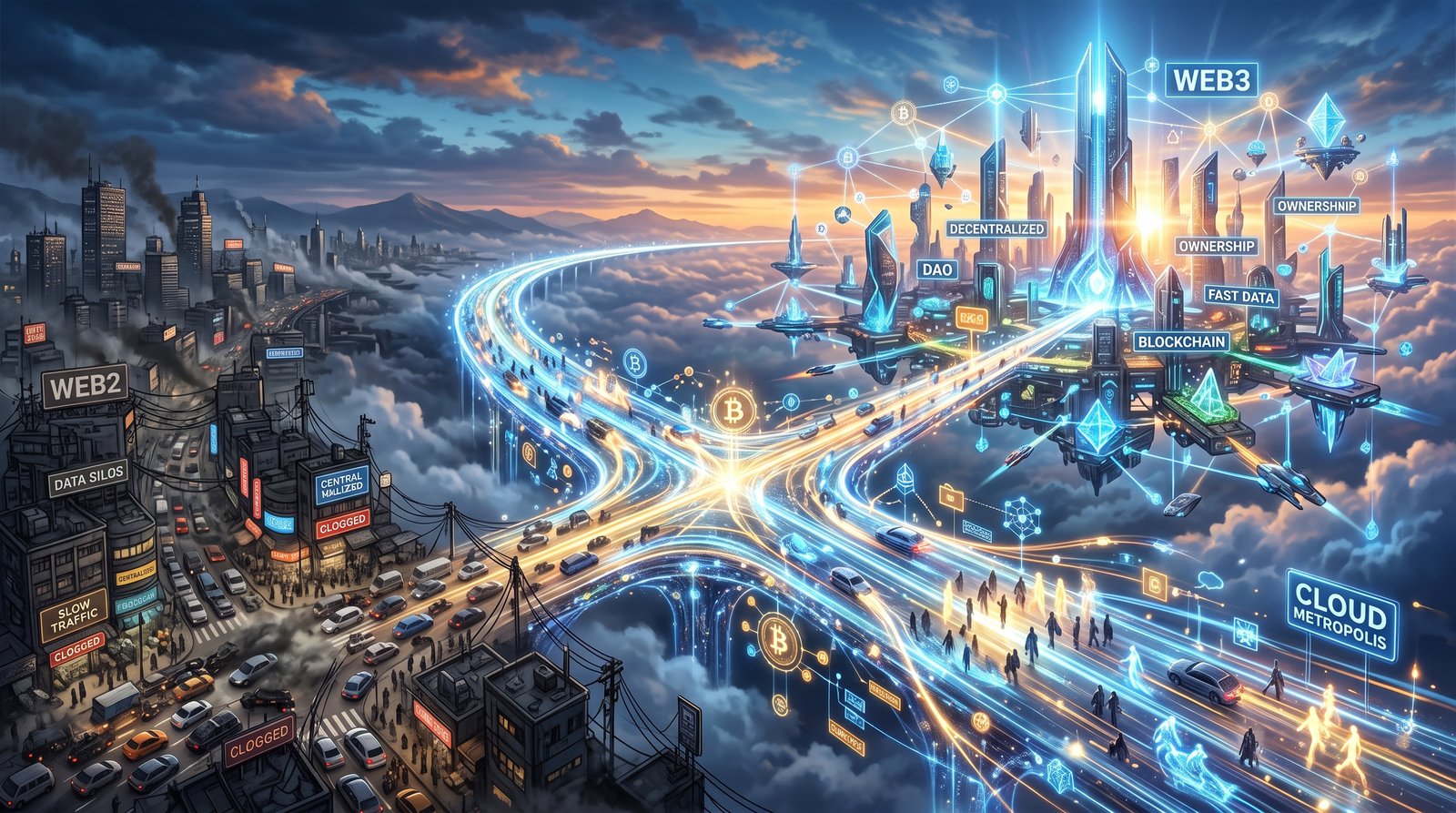
The internet is undergoing its most significant transformation since the invention of the World Wide Web. Web3 — the decentralized, blockchain-powered iteration of the internet — is fundamentally reshaping how value is created, exchanged, and owned in the digital economy. Unlike Web 2.0, where a handful of platform companies control user data and extract disproportionate value, Web3 shifts power back to individuals through decentralization, cryptographic ownership, and permissionless participation.
Understanding the Evolution: Web1 to Web3
To understand Web3's significance, it helps to trace the evolution of the internet through its three major eras:
Web1 (1990-2005): The Read-Only Web
The first generation of the internet consisted of static websites and basic HTML pages. Users were primarily consumers of content published by website owners. There was little interactivity or user-generated content. Businesses like AOL, Yahoo, and early Amazon dominated this era. The web was decentralized by default simply because there were few centralized platforms, but it lacked the functionality to support complex applications.
Web2 (2005-Present): The Read-Write Web
The second generation brought interactivity, social media, and user-generated content. Platforms like Facebook, YouTube, Twitter, and Instagram enabled anyone to create and share content. However, this centralization created immense power asymmetries. Platform companies own user data, control content distribution through algorithms, capture the majority of economic value, and can de-platform users at will. Web2 gave users a voice but not ownership.
Web3 (2020+): The Read-Write-Own Web
Web3 combines the interactivity of Web2 with the decentralization of Web1. Users own their data, digital assets, and online identity through cryptographic keys. Value flows directly between participants without intermediaries extracting rent. Governance is distributed through decentralized autonomous organizations (DAOs). Digital scarcity enabled by blockchain technology creates new economic models around NFTs, tokenized assets, and decentralized finance.
Key Principles of Web3
Decentralization
Web3 applications run on blockchain networks maintained by thousands of independent nodes rather than centralized servers controlled by a single company. This eliminates single points of failure, censorship resistance, and ensures no single entity can unilaterally change the rules or seize user assets.
Self-Sovereign Identity
In Web3, users control their digital identity through cryptographic key pairs rather than relying on platform-managed accounts. Decentralized identifiers (DIDs) and verifiable credentials enable users to prove attributes about themselves — age, credentials, membership — without revealing unnecessary personal information.
Token-Based Economics
Web3 introduces native digital assets — tokens — that align incentives between users, creators, and developers. Tokens can represent ownership in a protocol (governance tokens), access to a service (utility tokens), or ownership of unique digital items (NFTs). This token-based economic model creates new ways to fund, govern, and participate in digital platforms.
Composability
Web3 protocols are designed to be composable — they can be combined like Lego blocks to create new applications. A developer can integrate Uniswap's liquidity, Chainlink's price feeds, and Aave's lending market into a single application without asking permission from any of these protocols. This permissionless innovation accelerates development and creates network effects across the ecosystem.
How Web3 Is Transforming Key Sectors
Digital Ownership and NFTs
Non-fungible tokens (NFTs) have evolved far beyond digital art collectibles. They now represent ownership of music rights, gaming assets, real estate deeds, intellectual property, and identity credentials. In 2025, the NFT market processed over $25 billion in secondary trading volume across marketplaces like OpenSea, Blur, and Magic Eden. The music industry has embraced NFTs as a way for artists to sell directly to fans while retaining 90%+ of revenue compared to the 12-15% they typically earn from streaming platforms.
Decentralized Finance (DeFi)
As covered in our dedicated DeFi analysis, decentralized finance is replacing traditional financial intermediaries with smart contract-based protocols. Web3 enables anyone with an internet connection to access lending, borrowing, trading, and investment services without bank accounts or credit checks.
Creator Economy
Web3 fundamentally improves the economics for creators. Social token platforms allow creators to issue their own currency that fans can buy to access exclusive content, communities, and experiences. Platforms like Mirror enable writers to NFT-ize their articles and earn directly from readers. Streaming platforms built on Web3 distribute a higher percentage of revenue to musicians and video creators.
Gaming and Virtual Worlds
Web3 gaming introduces true digital asset ownership. In traditional gaming, players spend money on in-game items that remain locked within the game's ecosystem. Web3 games — like Axie Infinity, The Sandbox, and Decentraland — allow players to truly own their assets as NFTs, trade them on open marketplaces, and earn tokens that have real economic value. The play-to-earn model has evolved into play-and-earn, where fun remains primary but economic participation is a valued byproduct.
Supply Chain and Provenance
Web3 enables transparent supply chain tracking through blockchain-based provenance records. Consumers can verify the authenticity and ethical sourcing of products — from luxury goods to coffee to pharmaceutical drugs. Companies like Nike (through its .SWOOSH platform) and LVMH (through the AURA consortium) are using blockchain to authenticate products and engage customers through digital ownership experiences.
Web3 Infrastructure: Building the Decentralized Internet
Decentralized Storage
Protocols like IPFS, Filecoin, and Arweave provide decentralized file storage where data is distributed across a global network of nodes rather than stored on centralized servers. This ensures content permanence, censorship resistance, and eliminates reliance on single cloud providers.
Decentralized Domain Names
The Ethereum Name Service (ENS) and other blockchain domain systems replace traditional DNS with human-readable names (like yourname.eth) that also serve as cryptocurrency addresses and decentralized website hosts. Over 3 million ENS domains have been registered, with growing adoption for Web3 identities.
Decentralized Communication
Protocols like XMTP, WalletConnect, and Push Protocol enable direct, encrypted communication between wallets without centralized servers. This creates the foundation for decentralized social networks, messaging apps, and notification systems that respect user privacy.
Challenges Facing Web3 Adoption
Scalability and User Experience
Despite significant improvements, blockchain transaction costs and speeds still create friction for mass adoption. Layer-2 solutions are addressing this, but the user experience of managing wallets, seed phrases, and gas fees remains a barrier for mainstream users. Account abstraction and smart wallets are key technologies that will bridge this gap.
Regulatory Uncertainty
The legal status of tokens, DAOs, and decentralized applications varies widely across jurisdictions. The SEC's classification of certain tokens as securities, tax reporting requirements for crypto transactions, and the legal liability of DAO participants create uncertainty that slows institutional adoption and developer investment.
Environmental Concerns
While Ethereum's transition to Proof of Stake eliminated over 99.9% of its energy consumption, concerns about blockchain energy use persist. Newer blockchains are designed with energy efficiency as a priority, and the broader Web3 ecosystem is increasingly carbon-conscious.
Frequently Asked Questions About Web3
Is Web3 the same as cryptocurrency?
No. Cryptocurrency is one application within Web3, similar to how email is one application within the traditional internet. Web3 encompasses a much broader ecosystem including decentralized applications, identity systems, storage networks, and governance protocols.
Do I need technical knowledge to use Web3?
Basic Web3 usage — buying NFTs, using DEXs, or holding tokens — requires understanding wallets, gas fees, and transaction confirmation. However, user interfaces are rapidly improving, and account abstraction will soon make Web3 as accessible as traditional apps.
What is the biggest innovation of Web3?
Digital ownership. For the first time in the internet's history, users can truly own digital assets — transferring, selling, or using them across different applications without platform permission. This shifts the economic model of the internet from extraction to empowerment.
Will Web3 replace Web2 entirely?
Not entirely. Web3 will coexist with Web2 for the foreseeable future. Many applications will be hybrid — using blockchain for ownership and settlement while leveraging Web2 infrastructure for content delivery and user experience. The transition will be gradual as technology and regulations mature.
The Economic Impact of Web3
The Web3 economy has grown from virtually zero to over $300 billion in total market capitalization across cryptocurrencies, DeFi, NFTs, and infrastructure protocols. Beyond market value, Web3 is creating new economic structures that redistribute value more equitably. Developers earn through protocol treasuries and token grants rather than advertising revenue. Creators receive direct payments from fans without platform commissions. Users are rewarded for contributing data, attention, and liquidity to networks.
Projections from industry analysts suggest the Web3 market could reach $5-10 trillion in value creation by 2032, driven by the tokenization of real-world assets, enterprise blockchain adoption, and the emergence of decentralized physical infrastructure networks (DePIN). The transformation of the digital economy from centralized platforms to user-owned networks is not just a technological shift — it is an economic and social evolution that will define the next era of the internet.